SEO becomes stressful when rankings stay frozen despite effort, money, and time, and that frustration often pushes site owners to search for shortcuts like what is pbn link building. The concept promises control and speed, but the risk hidden behind it is far greater than the reward.
To understand the danger clearly, we must first define what is pbn link building in its real form, not the polished version often sold online.
Building on Sand: What Is PBN Link Building at Its Core
A Private Blog Network is a collection of websites owned by one entity and used only to place backlinks to a target site. These websites are usually built on expired domains which are old sites that once had authority and backlinks. The links look natural on the surface, but the intent behind them is artificial.
Search engines value links as votes of trust. PBNs attempt to manufacture those votes instead of earning them.
Why What Is PBN Link Building Sounds Logical to Beginners
Many people asking what is pbn link building are not trying to cheat. They are trying to compete. When competitors rank faster, PBNs appear to explain the gap.
- Google values backlinks, so more links feel like the solution.
- Expired domains already have authority.
- Control removes uncertainty.
- Results appear faster than outreach.
However, logic without compliance always ends badly in SEO.
The Invisible Footprints Nobody Warns You About
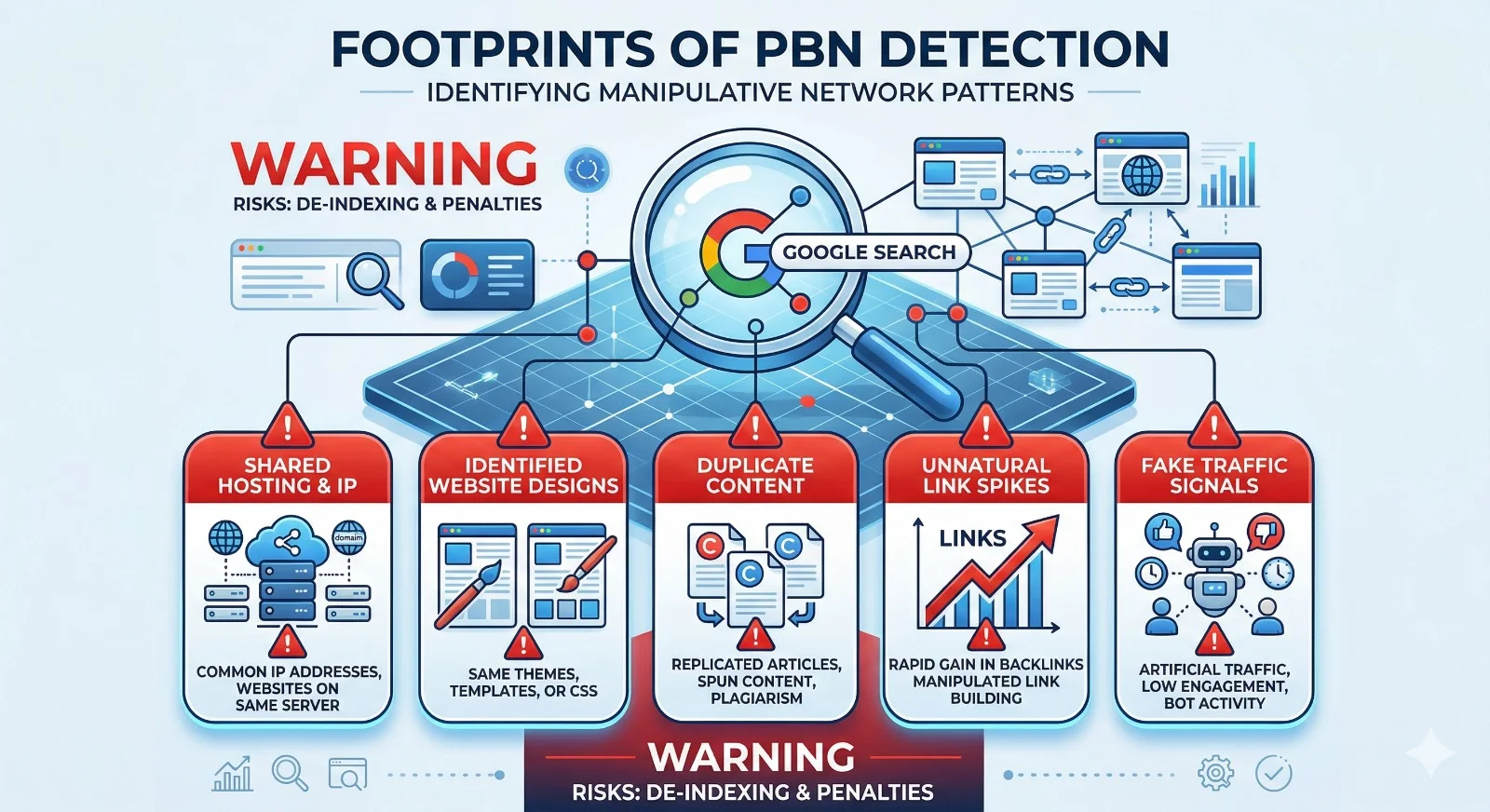
Most articles talk about penalties but ignore detection mechanics. This is where PBNs truly fail.
- Hosting similarities reveal ownership patterns.
- Content velocity means publishing speed looks unnatural.
- Traffic signals expose fake engagement.
- Link placement timing creates predictable behavior.
Google does not need to know who owns the sites. It only needs patterns.
A Stat That Explains the Real Risk
According to multiple SEO recovery case studies, over 65 percent of websites hit by unnatural link penalties lose more than 50 percent of their organic traffic within 30 days, and nearly half never return to previous ranking levels.
This is not speculation. It is a recurring pattern.
What Is PBN Link Building Doing to Your Brand Reputation
Most discussions stop at rankings, but reputation damage is often worse.
- Clients associate traffic loss with incompetence.
- Partnerships hesitate after visibility drops.
- Future link outreach becomes harder due to trust loss.
Once credibility is damaged, even clean SEO takes longer to work.
The Opportunity Cost Nobody Mentions
While managing a network, you are not building real assets.
- No editorial relationships are formed.
- No brand mentions grow.
- No audience trust develops.
- No authority compounds.
This is why PBN users feel stuck even when rankings rise temporarily.
PBNs vs Sustainable SEO Compared Simply
| Aspect | PBN Strategy | Sustainable SEO |
| Link source | Controlled sites | Independent publishers |
| Risk exposure | Extremely high | Minimal |
| Growth pattern | Spikes then drops | Slow but stable |
| Brand trust | Weak | Strong |
| Update survival | Poor | Consistent |
This table explains why shortcuts collapse under updates.
How Modern SEO Quietly Replaced PBNs
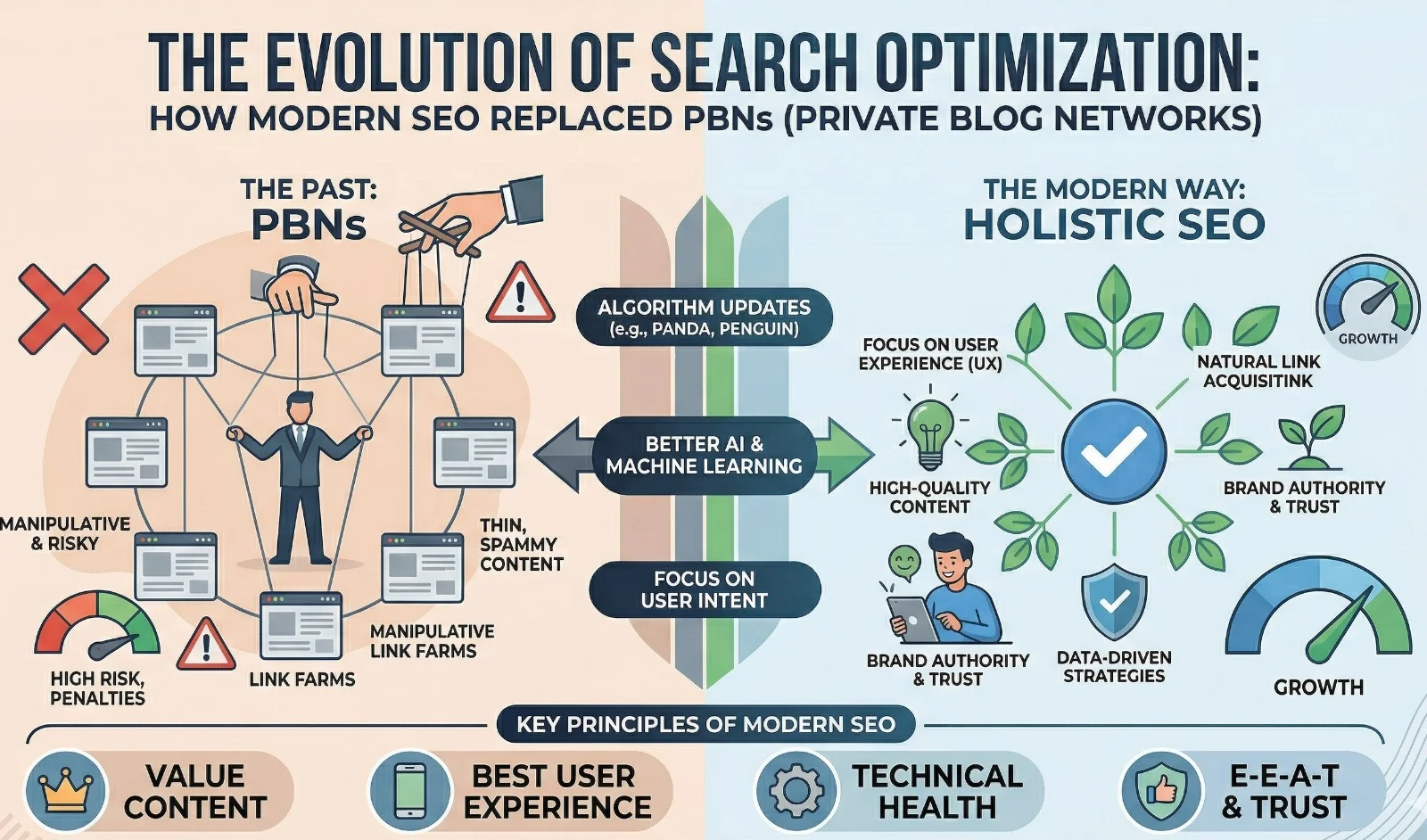
Instead of manipulating links, advanced SEO focuses on relevance and trust.
- Contextual niche links placed naturally.
- Digital PR earned through data and stories.
- Authority content that attracts citations.
- Relationship driven outreach.
This is the approach used by services like Postspack, where growth is built on credibility instead of concealment.
Can AI Replace Risky Link Building
AI does not replace ethics, but it improves execution.
- Finds relevant publishers faster.
- Analyzes backlink gaps.
- Improves outreach personalization.
- Predicts content that earns links naturally.
Used correctly, AI reduces risk instead of increasing it.
Questions People Ask but Rarely Get Honest Answers To
1. What specific footprinting techniques do search engine crawlers use to detect interconnected Private Blog Networks?
They hunt for patterns.If ten unrelated blogs all use the same WordPress theme, Google Analytics ID, hosting IP range, or even the same privacy policy template, that’s a clear footprint. They stitch these clues together to map the entire network.
2. How does the practice of “link velocity manipulation” via PBNs differ from a natural backlink profile growth pattern, and why is it a detection vector?
Natural sites earn links sporadically. A few this month, maybe none next. A PBN launch often looks like a cliff: 20 “authority” links all appear overnight from brand-new blogs that mysteriously all mention your site. That sudden, perfect spike is a huge red flag for algorithms.
3. From an infrastructure perspective, what are the minimum requirements for hosting a PBN to avoid basic IP and server-level footprinting?
You can’t use one hosting account. Each site needs its own separate hosting provider, preferably on a different C-class IP block. Your registrar details and DNS providers should also be varied. One shared server or registrar for all sites is asking to get caught.
4. Explain the concept of “Content Quality Thresholds” in PBN maintenance. What measurable metrics (beyond word count) separate detectable, low-quality PBN content from content that might pass a manual review?
It’s not about length. It’s about originality. If you spin the same article across 50 sites, tools will spot the duplication. Quality means unique images, a natural writing voice, and actual research. Low-quality PBNs are filled with obvious, keyword-stuffed fluff written for bots, not people.
5. What is the technical process for auditing and repurposing an expired domain for PBN use, specifically regarding residual backlink equity and historical penalty checks?
You don’t just buy a name. First, you dig through its backlink history with tools like Ahrefs to see if its old links are toxic. Then, you check the Wayback Machine to see if it was a spam site. If it was penalized or full of casino links, its “authority” is poisoned and will hurt you.
6. How do modern E-E-A-T (Experience, Expertise, Authoritativeness, Trustworthiness) guidelines impact the effectiveness of PBNs that lack genuine author biographies and verifiable entity associations?
It kills them. A real expert has a traceable history. PBN “authors” are usually fake names with stock photos and no online presence. Google’s systems are built to spot this lack of real-world trust signals. No genuine author, no E-E-A-T, and ultimately, no ranking power.
7. In the context of HTTP headers and server responses, what technical details can inadvertently link PBN sites together?
Small server signatures give you away. If every site sends back the exact same version of Apache in its header, uses identical cookie names, or has the same caching setup, it’s a technical footprint. It shows one person configured all the servers, linking the sites.
8. What is the cascading risk model when a central “hub” site in a PBN is penalized? How does link equity flow and penalty risk propagate through the network’s topology?
It’s like a spider web. If Google catches and penalizes the main hub site that links to all your others, that penalty can travel down every link. Instead of just losing one site, you can trigger a chain reaction that wipes out your entire network because the connections are exposed.
The Reality You Cannot Ignore
SEO success is about durability, not speed, and what is PBN link building sacrifices stability for temporary movement. The moment control replaces trust, risk replaces growth. Brands that want lasting rankings choose strategies that compound over time, which is why Postspack focuses on real authority-building rather than shortcuts that collapse when algorithms change.
If long-term visibility matters, the direction is already clear.