Every website owner chasing better rankings faces the same core question: what is an editorial link and why does it matter? Cutting through the noise of paid schemes, one truth stands apart. The only link with real power is the one you earn. This genuine, natural link is the foundation of lasting SEO authority. In this Postspack guide, we break down this critical asset. It is time to stop chasing links and start attracting the right ones.
The Unbuyable Vote of Confidence

An editorial link is the ultimate digital seal of approval—a genuine endorsement that cannot be purchased.
In simple terms, it’s a link another website gives you freely, not because you paid or traded for it, but because your content is too valuable for their audience to miss. It’s a voluntary, one-way inbound link placed within relevant text by an editor or creator who believes your work enhances theirs.
- Voluntary and Unpaid. There is no contract or transaction involved; it’s given purely because the content deserves it.
- Contextual & Relevant: Placed naturally within content that aligns with your topic.
- A Merit-Based Signal: Functions as a trustworthy link that tells search engines your site is an authority.
This is the core distinction: it’s not an ad. It’s an editorially given link—a digital high-five from one expert to another. It’s proof that your content doesn’t just exist; it deserves to be cited.
According to a recent INDUSTRY SURVEY, websites with a high percentage of editorial links in their backlink profile rank, on average, 35%higher for competitive keywords than those relying on artificial link building.
Why Editorial Links Dominate the Algorithm
The supremacy of the editorial link is not accidental. Search engines like Google are designed to mimic human judgment, and nothing is more human than a genuine recommendation.
- They Pass Unfiltered Authority:
An editorial link from a high-domain-authority site acts as a direct conduit for link equity, boosting your page’s ranking potential.
- They Are Inherently Contextual:
These contextual links are embedded within relevant content, providing clear thematic signals to search engines about your page’s subject matter.
- They Build Lasting Trust
A profile rich in editorial links directly supports your site’s E-E-A-T (Expertise, Experience, Authoritativeness, Trustworthiness) score, a core part of Google’s quality evaluation.
The following table illustrates the stark contrast between what is an editorial link and a typical paid link:
What is an Editorial Link vs. Paid Link vs. Google’s Interpretation
| Feature | Editorial Link | Typical Paid Link | How Google Interprets It |
| Primary Motivation | Content value and relevance | Financial transaction | Editorial = trustworthy. Paid = suspicious intent. |
| Placement Context | Natural placement inside relevant content | Inserted in ads or unrelated sections | Natural positions = valuable. Forced placements = devalued. |
| Link Equity Passed | High equity, strong trust signal | Low or none, often nofollow/sponsored | Equity flows only through natural, trusted links. |
| Algorithmic Risk | Zero risk | High risk of penalties | Paid links violate guidelines → potential punishment. |
| Longevity & Stability | Permanent and durable | Temporary; removed when payment ends | Stability = ranking trust. Instability = weak signal. |
| Editorial Review | Strict checks, quality focus | Minimal checks, payment-first | Editorial curation = authenticity. Paid = manipulation. |
| User Experience Impact | Helps readers, adds context | Breaks flow, feels promotional | Helpful UX = rewarded. Poor UX = ignored/penalized. |
| Cost | Free (earned through value) | Pay-per-link or monthly rental | Free, earned links = legitimate growth. Paid = manipulative. |
| Traffic Quality | High engagement & targeted visitors | Low-quality or uninterested clicks | Real engagement increases trust. Low engagement has no weight. |
| Authority Signal | Strong relevance & credibility boost | Weak or neutral authority | Editorial links boost E-E-A-T. Paid links don’t. |
| Scalability | Slow but compounding long-term | Fast but short-lived | Sustainable growth beats shortcuts. |
| Brand Reputation Impact | Increases trust, builds authority | Damages trust if exposed | Trusted brands rank better. Shady practices reduce trust. |
| Publisher Incentive | Serve audience with value | Monetize outbound links | Editorial motives align with ranking factors. |
Stop Chasing, Start Attracting: Your Action Plan
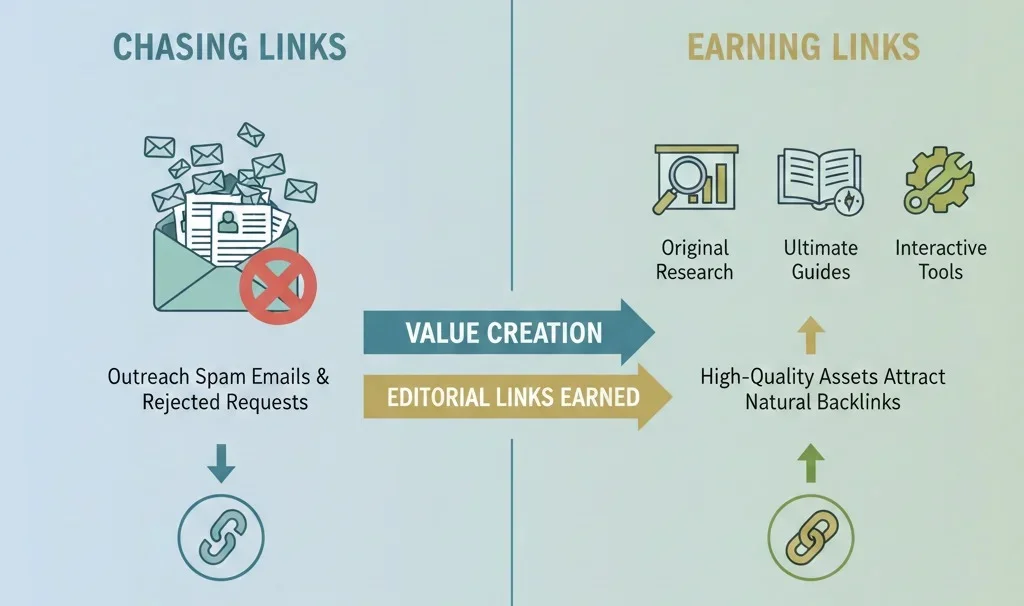
The process is simple in theory but requires discipline: you must build assets that demand citation.
Start by creating what I call “link-worthy pillars.” These are definitive resources that fill a clear gap for your entire industry. When someone needs the best information on a topic, your page should be the obvious answer.
Forget outreach for a moment. Focus on creating content worthy of a genuine what is an editorial link answer. Here’s how:
- Publish Original Research. Unique data is the single most powerful link magnet. Conduct your own survey, analyze industry trends, or share proprietary case studies. People cite primary sources.
- Build the Ultimate Guide. Don’t just write a blog post. Create the most comprehensive, clear, and updated resource on a specific subject. Become the textbook for your niche.
- Master the Skyscraper Technique. Find a popular piece in your field,
- make it better
- more complete
- better designed
- more actionable
- strategically share your superior version.
- Solve a Universal Problem. Create a free tool, template, or calculator that saves people time or money. Utility gets bookmarked, shared, and linked to in tutorials.
This is where strategy meets execution. Platforms like Postspackexcel operationalize this principle. We help architects with these link-worthy assets and foster the authentic publisher relationships that turn great content into earned, placed links—the kind that builds real link earning success.
The Most Common Paths to an Editorial Link
While methods vary, several proven strategies consistently yield editorial links. Remember, the core principle is providing undeniable value to another site’s audience.
- Data-Driven Original Research: Publishing unique surveys or studies makes you a primary source. Journalists and bloggers actively seek credible data to cite, leading to powerful authority links.
- The Skyscraper Technique: Identify a popular piece of content in your niche and create something objectively better—more comprehensive, updated, or visually superior—then outreach to those who linked to the original.
- Expert Roundups and Contributions: Participating as a quoted expert in an industry article can result in a natural link back to your site. Similarly, contributing a guest post link to a reputable publication, when the content is high-quality and non-promotional, is a classic editorial play.
- Creating Essential Resource Pages: Building “Ultimate Guide” or “Top Tools” lists that objectively help people can earn you resource link placements from grateful webmasters.
Frequently Asked Questions
1. Beyond the basic definition, how does Google actually view an editorial link compared to other backlinks?
2. Can a link from a guest post I write still be considered a true editorial link?
3.What’s the single biggest mistake people make when trying to earn editorial links?
4.How can I identify if an existing link to my site is editorial or not?
5.Do social media shares or brand mentions without a hyperlink count as editorial links?
6. Why are editorial links considered more durable and “safe” from algorithm updates?
7. What’s a realistic first step to earning my first editorial link?
8. In a world of AI-generated content, will the value of an editorial link increase or decrease?
Conclusion
In the messy world of SEO, one thing stands clear: the only thing that really builds lasting authority is the editorial link. It’s not a trick you buy. It’s trust you earn.
That’s the real answer to what is an editorial link. It’s proof your work matters to people who know better.
Shift your entire focus to earning that proof. Build something worth citing. That’s how you build rankings that don’t break with the next Google update. For a structured path to get there, platforms like Postspack provide the strategy and relationships to turn great content into genuine endorsements.
Start by earning your first one. Everything else follows from there.